
Time as Life
The Science of Chronobiology

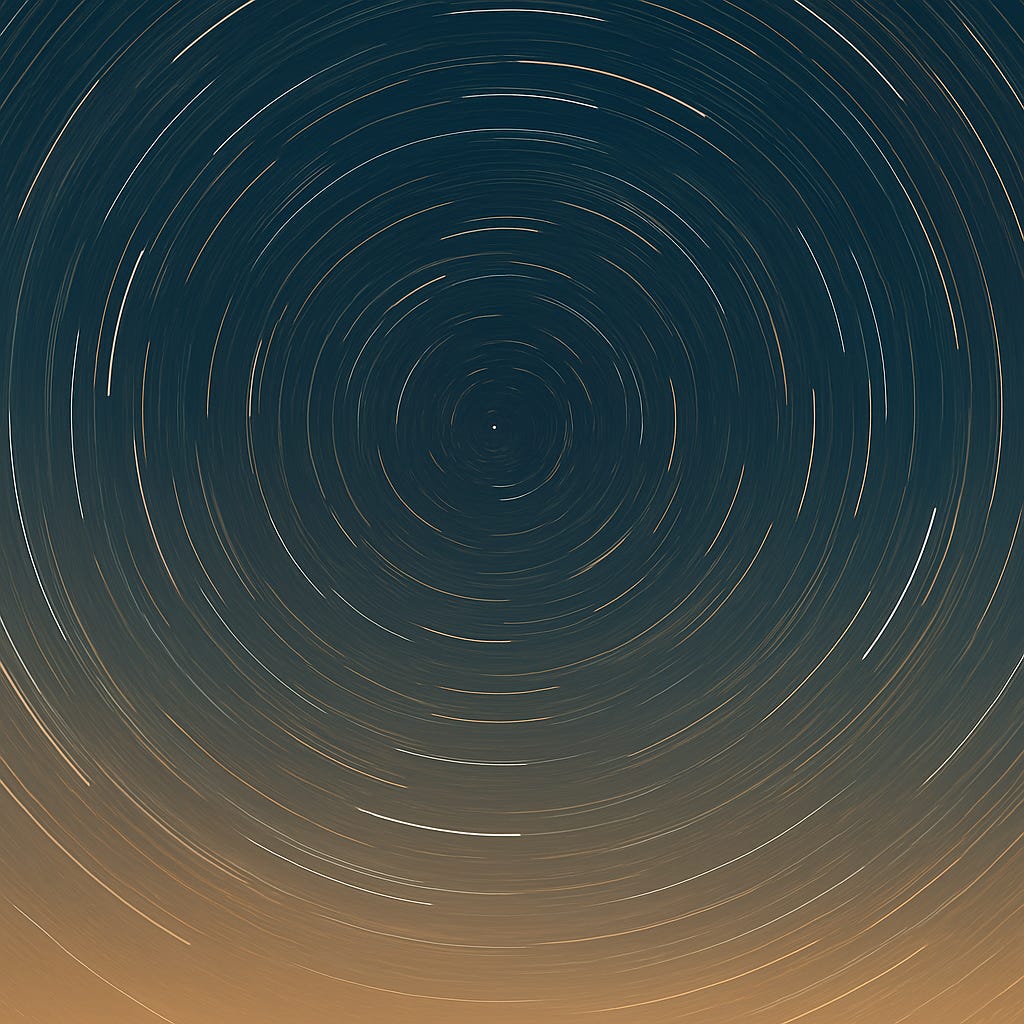
This essay builds on the Biomythology scientific primer, translating the science of chronobiology into something more personal — a reflection on what it means to live in time, not against it.
As long as there have been people wandering the earth, there have been people pondering the essence of time. Before clocks or calendars, we knew instinctively that time was the most limited resource of all. It is the medium we live in—real as air or water—yet invisible unless it slips. Every breath, heartbeat, and flicker of thought unfolds within it. As such, time is not merely something we measure; it is something we wear, something we inhabit.
Modern science has confirmed what our ancestors only felt. Every one of our roughly forty trillion cells contains a tiny timekeeper—a molecular “wristwatch” that runs on a 24-hour cycle. These cellular clocks control the daily ebb and flow of hormones, body temperature, metabolism, and alertness. They decide whether your liver is ready for breakfast or your muscles are primed for a workout. In the 1970s, researchers studying fruit flies discovered that certain genetic mutations destroyed these daily rhythms. Decades later, Jeffrey Hall, Michael Rosbash, and Michael Young mapped the feedback loops behind them—work that earned the 2017 Nobel Prize in Physiology or Medicine [1].
At the top of this timekeeping hierarchy sits a small structure deep in the brain: the suprachiasmatic nucleus (SCN). About the size of a grain of rice, the SCN receives light directly from the eyes and acts as the body’s master clock. When daylight hits specialized retinal cells in the morning, they send a signal to the SCN, resetting the body’s internal time to match the external day [2]. The SCN, in turn, coordinates rhythms in nearly every organ through subtle changes in hormone levels, temperature, and nerve activity.
When these systems run in sync, the body hums along effortlessly. But when light and behavior fall out of step—through night shifts, jet lag, or scrolling under blue light at midnight—things unravel. Even dim evening light can suppress melatonin, the hormone that signals night to the body, and delay the master clock’s ability to keep time [3]. Eating late compounds the problem: studies show that a midnight meal can raise blood sugar 20–30 percent higher than the same meal at noon [4]. Over time, these small misalignments contribute to insulin resistance, obesity, mood disorders, and cognitive decline [5].
Our rhythms extend beyond the 24-hour cycle. Faster ultradian rhythms—like heartbeat, breathing, or 90-minute focus waves—govern our moment-to-moment function. Infradian rhythms, such as the monthly menstrual cycle, influence mood, metabolism, and immunity. Longer still are circannual rhythms, the body’s quiet adaptation to the seasons: daylight length, temperature, and food availability alter everything from sleep depth to fertility [6]. Even development follows its own tempo. Teenagers naturally drift toward later bedtimes, while older adults wake earlier and nap more—proof that time shapes us across the lifespan as much as across the day.
So what happens when these rhythms lose their coherence? In the short term, you feel it as fatigue, poor concentration, and metabolic sluggishness. But chronic disruption carries heavier costs. The World Health Organization now classifies long-term night-shift work as a probable carcinogen because of its association with elevated risks of breast, prostate, and colorectal cancers [7]. Circadian misalignment also impairs cardiovascular and immune function, accelerating biological aging. Researchers link it to mitochondrial dysfunction, chronic inflammation (“inflammaging”), and reduced DNA-repair capacity—three of the central Hallmarks of Aging [8].
The inverse is also true: restoring rhythm strengthens resilience. Time-restricted feeding (TRF)—eating within an 8–12-hour window aligned with daylight—improves mitochondrial function and metabolic health even without reducing calories [9]. In humans, prolonged nightly fasting is associated with lower cancer risk [10], and early-day eating windows enhance glucose control and cellular cleanup (autophagy) [11]. Light, too, acts as medicine: bright morning exposure anchors the circadian clock and improves sleep quality, while minimizing screens after sunset preserves melatonin [12]. Consistent light cues have even been shown to enhance immune function, increasing the body’s ability to respond to vaccination [13].
These findings bring us to a crucial distinction: Lifespan measures how long we live; healthspan asks how many of those years are lived well—strong, clear, and independent. When the body’s clocks fall out of sync, healthspan contracts. Mitochondria falter, inflammation smolders, DNA repair slows, and proteins misfold [8]. But when timing aligns—when light, food, movement, and rest follow their intended rhythm—the same processes that age us begin to slow.
Chronobiology reveals that rhythm is not just an aesthetic idea; it’s a survival strategy. Aligning your life with your body’s natural timing—seeing morning light, eating in daylight hours, resting in darkness—turns everyday behaviors into medicine. As researchers increasingly recognize, synchrony across the body’s cellular and systemic rhythms may be one of the most powerful yet under appreciated determinants of long-term health [14].
To live well is to live in rhythm. To live long, strong, and clear is to live with time, not against it.
References:
Nobel Assembly at Karolinska Institutet. The 2017 Nobel Prize in Physiology or Medicine – Press Release. 2017.
S. Tomatsu et al., “Clinical Chronobiology: Circadian Rhythms in Health and Disease,” Seminars in Neurology 45, no. 3 (2025): 317–332.
L.A. Schrader et al., “Circadian Disruption, Clock Genes, and Metabolic Health,” Journal of Clinical Investigation 134, no. 14 (2024): e170998.
B. Peters et al., “Meal Timing and Its Role in Obesity and Associated Diseases,” Frontiers in Endocrinology 15 (2024): 1359772.
V.A. Baidoo and K. Knutson, “Associations between Circadian Disruption and Cardiometabolic Disease Risk,” Obesity 31, no. 3 (2023): 615–624.
T.A. Wehr, “Melatonin and Seasonal Rhythms,” Journal of Biological Rhythms 12, no. 6 (1997): 518–527.
International Agency for Research on Cancer (IARC), Monograph Volume 124: Night Shift Work, World Health Organization, 2020.
C. López-Otín et al., “Hallmarks of Aging: An Expanding Universe,” Cell 186, no. 2 (2023): 243–278.
A. Chaix et al. ’Time-Restricted Feeding Prevents Obesity and Metabolic Syndrome in Mice Lacking a Circadian Clock’. Cell Metabolism 29, no. 2 (2019): 303-319.e4.
C.R. Marinac et al., “Prolonged Nightly Fasting and Breast Cancer Risk,” JAMA Oncology 2, no. 8 (2016): 1049–1057.
S. Sutton et al., “Early Time-Restricted Feeding Improves Insulin Sensitivity and Blood Pressure,” Cell Metabolism 27, no. 6 (2018): 1212–1221.
S.D. Wright et al., “Entrainment of the Human Circadian Clock to Natural Light,” Current Biology 23, no. 16 (2013): 1554–1558.
S. Cermakian et al., “Circadian Control of Immune Responses and Vaccination Efficacy,” Nature Reviews Immunology 19, no. 8 (2019): 479–493.
A. Ramkisoensing and J. H. Meijer. ‘Synchronization of Biological Clock Neurons by Light and Peripheral Feedback Systems Promotes Circadian Rhythms and Health’. Frontiers in Neurology 6 (June 2015): 128.